The trouble I have seems to arise whenever I come home late from a particularly long and draining day at work. I'm tired and, looking for a quick pick-me-up, I turn to Facebook hoping for a funny story or to be able to leave a light-hearted comment somewhere. Instead I quickly find myself being discouraged by the amount of criticising, complaining and condemning. We are so archaic because we don't have daylight savings. The shops aren't open early enough, late enough, long enough. We have to work extra shifts. We're so angry because there are stupid people who don't agree with our opinions. Or we're so convinced of our opinions that we'll voice them however and whenever we like. Let's broadcast our uncensored thoughts of whoever has upset us most recently. Where are our tax dollars going? We want more, we haven't got enough, we missed out. We've had a bad day.
But I didn't. I had a great day. I went to work - a three-and-a-half hour drive there and a three-and a-half hour drive back at the end of the day. I can't complain though, because my newest apprentice had an hour on a bus before even getting in the van with us. Then, when we arrive at work we have to walk a slippery path uphill, each of us carrying boxes packed with books and things. Doesn't sound like the makings of a great day to you? Let me explain a little more.
Today I had a meeting at the home of my co-worker, invaluable assistant and friend. I hadn't seen her in nearly a month, so I suppose that was the biggest part of what made it a great day. But, more than that, I love a visit to her house. There is something there that can't be seen in too many places and I would like to try my best to show it to you.
This house, as I've mentioned, is built on the side of a hill. The land was given to people who were unable to buy land elsewhere and some who had lost homes in the tsunami. They've settled up here and made a home of it - a small community. You can't access the houses by road - though the houses on flat ground have good infrastructure and there is a large town not far away. We park the van on a small field at the base of the hill and then have to walk the small path that has been worn into the hillside by those who go and come. It is not a long walk, but it is gravelly, a bit slippery for those of us who may fall a little on the clumsy side of things, and a small challenge if you have to carry things with you in the heat of the day. Still, I love the walk. It reminds me of when I was a kid living in the bush, always running off to go exploring amongst the trees and following the paths I discovered. I miss that.
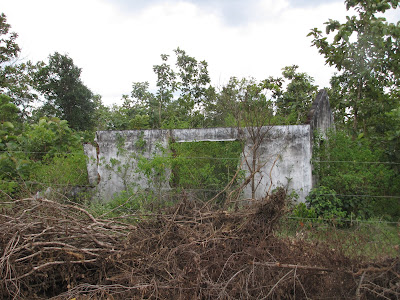
About halfway along my walk I will pass a plastic tank - like a rainwater tank, only smaller - and a . . . hmmm, I'm not sure I know how to describe it. It is about the size of a small meeting hall but it is only the floor and half-walls in the parts where it has been built into the sides of the hill. I think it is partly tiled and partly concrete. I can't describe it too well because I know what it is and, seeing as most times I've gone past it has had people in it, I usually avert my eyes. Along part of the perimeter of the rectangular construction runs a small ditch with a pipe through which, I'm pretty sure, trickles water from the tank. A small part of the 'hall' is separated by a half wall, with a drain to let water out and a plug to keep it in. I suppose it's a bit like an empty swimming pool. This is a communal bathroom. People living on the hill will come here to bathe and to wash their clothes. (It might be worth pointing out that they don't bathe naked. I avert my eyes because I figure if I had to bathe in an open-air bathroom, I don't think I'd appreciate any old passer-by watching me like I was a TV programme.)
The tank is the community's water supply. The houses don't have running water. They don't have electricity either. Each day they will walk down the hill, fill a bucket and carry it back to the house. At my friend's house they then pour it into a large pot and then return for more. She says it takes three trips to fill the pot. Apparently, after the land was given, the government declared that there was the risk of landslides in the area and that it would be unsuitable to put in water or electricity connections. I have been told that a few attempts have been made, prior to elections, to put water connections in but these attempts have ground to a halt after each election.
At least it is not too long a walk from there up to my friend's house, though the incline does increase at this point. Then up a few steps and you're there! A perfect example of the premise that the most beautiful places take a bit of extra effort to get to. My friend lives here with her mother - her father having passed away years earlier - and other family members live nearby. Whenever I have come, it has been to a house of women - smiling, happy, welcoming women. My friend has clearly learnt from her mother, because both always carry a beautiful, big smile, and it seems to rub off on anyone who walks through the door. It's not an empty house; it's a house of happiness.
It's a great house - well-kept with a sweet little garden out the front. It's not a shack, they have worked hard and waited patiently to build something suitable. It's not fancy compared to what you might be used to but it's got what is needed. The main room has a table and a comfy place for guests to sit, while a large, open window lets in cheery sunshine and a cooling breeze. There's a kitchen and also, in faith, a bathroom which doubles as a storeroom while waiting for the day when there might be running water. Because they can't build back, right or left - the house is built hard against solid rock - they've built up. Go upstairs and you get a beautiful view looking down from the hill across all the greenery. Words at the back of my mind try to push their way forward - something about 'meek' and 'inheriting the earth'?
We are welcomed in and my friend's mother is soon busy making tea for us all and putting together a meal of cake and bananas. There's more than we all could eat. My friend takes our new worker outside with a bucket of water so she can wash her hands and face and freshen up after our travels. That simple act of hospitality takes on so much more meaning when you realise that it is one-third of their water-holding capacity, one trip down the hill and back, given away so generously, without holding back.
And then it is down to business. I am finally home at about 7pm, tired but satisfied. And then - I should know better, I really should - I look at facebook. I look, and then all the energy that remains in me at the end of a long day seems to be sucked right out. How can we who have so much complain about so little, while those who have so little seem to live with such satisfaction? (Though, don't be fooled; I know full well these are generalisations to which there are definitely exceptions!) Why are we standing in the shower (and a hot shower at that!), whinging about our day, while elsewhere someone is giving away a bucket of their hard-earned water and their smile doesn't waver at all? It doesn't bother me so much that we do it, - we all have moments where we just throw away words - it's just that sometimes I wonder if we even realise that our grievances are so petty. It's not that we get upset, it's that we get upset out of proportion.
Now I'm worried I might be sounding sanctimonious or hypocritical (whinging about whinging) or I might have got you thinking, "Is she talking about me? She's talking about me, isn't she?" No, I'm not talking about you. So I wanted to confess how I have caught myself getting upset out of proportion and tell you about the kick in the pants that I got which I now use to remind myself whenever I start getting upset out of proportion.
I had an early start for work one morning and a two hour drive ahead of me. I hadn't been getting much time off and I was already tired before I left. I was expecting the day to be hot and long and I knew that when I got home I would be expecting an overnight guest. I must confess, I started to get a bit whiny with myself. Oh, how much I do! Oh, how much more I deserve! I just wanted to get things over and done with. (Oh, how bad I feel as I write this confession!)
The people we were going to see had left their home to go and work in a difficult area, helping others. They have been there for several years now. Their work isn't easy but they keep at it. Several times, someone has come along and offered to help them with what they're doing but eventually those people have left again because they found the work too difficult or needed something that provided more financially. As we spoke together, the lady broke into tears. She told of how discouraging it was to have people leave them time after time. She also spoke of how isolating it felt to be struggling with this work alone.
So, as you might imagine, I was hanging my head in shame at right about this point. Here I had been feeling like I was the noble martyr for going out and doing for one day what she was doing every day of her life. How humbling. It threw a whole lot of perspective at me that I thought it might be good to hang on to. Since then, whenever I become tempted to let the things that are irking me get out of proportion, I remember that morning. A bit of perspective makes a world of difference.
What I could hear her yearning for was a sense of being connected, of not being alone. And I suspect part of what is behind the generosity and satisfaction that fills my friend's house is that sense of community looking out for each other. And I suppose our problems do start to blow out of proportion when we lose sight of the wonderful things we do have, like the people around us who support us. One thing I have learnt from Facebook is that even though there are a multitude of things that people can say that can drag us down, and even though there might be a small number of people with something positive to say, just one word from a person like that will lift us higher than any negativity around. I'll take a person like that wherever I can find them and I want to be one of those people. So I suppose, for now, Facebook gets to stay. Besides, I like the games.




 Posts
Posts

