Tuesday, June 29, 2010

GO FIGURE

Driving from Negombo to Moratuwa - a drive that takes me through the capital - I have discovered that I pass at least 100 people every minute. This count is based upon timing how quickly I can count 100 people. Therefore, it doesn't include passengers in buses nor people in crowds that are too large for me to count as we drive past. Neither is this an average; I discovered that I could easily count 100 people every minute. Based on this, during the five hours of a return journey to Moratuwa, I pass at least 30 000 people.

The drive from Negombo to Yakwila for my Tamil lessons takes me in the opposite direction, out to rural areas. Here I find that it takes me two minutes to pass 100 people (again, discounting buses). This result has been confirmed by repeated tests. Therefore, in the hour and a half that it takes to do a return journey to Yakwila, I pass at least 4 500 people. Not in the vicinity of the previous figure but still rather impressive, considering location.

Both trips produced a tally of around 70 stray dogs. The Yakwila trip tallied around 35 cows, compared to the Moratuwa trip, which tallied around 40. I found it surprising, even given the difference in lengths of the journeys, that there were more cows to be seen driving in the urban areas than in the rural areas. In fact, the cows out Yakwila way were usually in pairs whereas it was the urban areas where I saw herds. Both trips produced sightings of one goat and one cat.

I think these figures show two things. Firstly, population density in Sri Lanka is on a scale that would blow the mind of the untravelled Australian - even in built-up areas, where the population is still readily visible, as compared to Australia, where the population is usually inside vehicles or buildings. In Sri Lanka, you are constantly reminded that you are never alone. I guess that's what you get for fitting a population about the size of Australia's inside a land area about the size of Tasmania. Secondly, I need to find some new past-times to occupy myself during my many long journeys.

Monday, June 7, 2010

WELL, I NEVER . . .

TEN FOODS I HAD NEVER TRIED BEFORE MOVING TO SRI LANKA

1) King Coconut Juice. A very thick, clear liquid; king coconut juice is not the same as coconut milk. It is very filling and I can not drink a whole coconut's worth. It doesn't have a strong flavour but it can take you quite by surprise if, when served in a glass, you thought you were drinking water.

2) Salted Cordial. This must be an acquired taste. The problem is that when you are offered cordial you can never know if it is salted or not. There has been many a time when we have gratefully accepted a drink only to given a salty surprise.

3) Peppered Pineapple. Sri Lankan pineapple has to be the best pineapple in the world. Why on earth they want to pepper it is beyond me!

4) Wattalapan. Wattalapan is a gelatinous pudding, a bit like a creme caramel. It is sweet, brown and nutty. Sri Lankan dessert menus are never very long - dessert is typically fruit salad, perhaps with some icecream - so this traditional dish is a bit of a local celebrity.

5) Kottu Roti. A mix of roti (flat bread), vegetables, chicken and spices, chopped into thin slices by some pretty impressive knife work, cooked on a grill and served in a pile. Yummo! We prefer ours without the bones but we are told that Sri Lankans like to see the chicken bones in the kottu roti so they know the cook isn't tricking them by adding poor chicken meat. The man we buy kottu roti from was so confused by our request for no bones that, for a while, he was sending the bones along to us in another bag so that we could be reassured that we were getting what we paid for.

6) Curried Mango. Not for me, but if you're a fan of mangoes and curries, it might appeal. As with the peppered pineapple, I'm not quite sure why anyone would want to do this to such a delicious piece of fruit.

7) Cream Soda. Not red creaming soda, just creaming soda, this soft drink is a pure sugar hit. Needless to explain then, I love it.

8) Brinjol. A vegetable somewhat akin to a zucchini (which I love) and an eggplant (which I hate). I know a guy who prepares the yummiest brinjol. I'm yet to make him teach me how.

9) Breadfruit. Breadfruit, when cooked and prepared, is a bit like potato. The aforementioned man cooks it with coconut milk and spices to make a very tasty dish. Once again, I'm not in on the secret. Perhaps some cooking lessons are in order. Don't confuse breadfruit with jackfruit, which is a large prickly fruit that looks a bit like durian and is, in my opinion, rather dry and tasteless.

10) Kangaroo Meat. We brought some back by request for some friends of ours. They had tried it in Australia and their children had loved it. It wasn't that bad, actually, considering that my mind connects kangaroo meat with the horribly smelly dead animal that my dad once got to feed the dog with. Not the greatest though, a little chewy. I think it was the marinade that I liked. Still, I think it is nicely ironic that my first - and probably only - taste of kangaroo meat was an overseas experience.

Friday, June 4, 2010

THE THONG THEORY

I have a theory that the world is filled with, for lack of a better word, a 'magic' that is all around us, masqueraded in the mundane. I'm not talking magic like sorcery and mysticism, but more a sense of wonderment that we only experience when we allow ourselves to be aware of it. It's nothing fancy or expensive and it rarely announces itself and yet it displays itself every day, right under our very noses. Allow me to illustrate by explaining the 'thong theory'.

First of all, let me be clear that in the Aussie vernacular, 'thong' refers to an item of footwear, not an article of ladies underwear. A significant difference, it is true, so for readers of other nationalities it might be appropriate to read 'slipper' or 'flip-flop' in place of the word 'thong'. Now that we are on the same page, I shall continue. Imagine, if you will, a single thong, marked with the grubby outline of a foot; it is probably old, perhaps even battered. Following the pattern of one of life's phenomena, it finds itself awash at sea. It's origin is unknown; perhaps it has been discarded, perhaps the tides stole it from an evening fisherman. How it got there, however, hardly seems an issue because it's just a thong. It's not an expensive runner or a chic heel; it doesn't even belong to someone's favourite pair of comfortable shoes. When its absence is noticed, if it is even noticed at all, it will probably be replaced without a second thought. It is just an insignificant piece of footwear being tossed about on the vast expanse of the ocean.

Now imagine the journey of this insignificant piece of discarded rubber. It floats over coral reefs, alive with fish of all colours, shapes and sizes. It floats past amazingly oversized whales, a bare speck in comparison. It floats alone in the deepest parts of the ocean, where even few vessels would dare to travel. It experiences the storms of the deeps; is thrown by waves that would inspire fearful awe. It is pushed by gentle breezes over calmer waters. Sharks swim silently beneath and it is unafraid. Dolphins leap playfully about it. It is carried through waters of every hue of blue and green. It allows the waters to push it forwards as, all around, mother tortoises are making their remarkable journey towards the moonlit shores to bury their treasured eggs in the sand. As the light of the rising sun sweeps over the land, the thong is found resting on sands never imprinted by the feet of humans, on a postcard-perfect beach.

In a most unspectacular manner, the thong has undertaken a most spectacular journey and nobody has noticed. It has been where most of us would pay good money to holiday. It has been within touching distance of some of the wonders of nature. It has been to places that most of us will only ever experience from the other side of a television screen. It has faced danger with the courage of a hero and yet will never be given a medal. It has travelled the oceans like a solo yachtsman and yet we will never see its photo in the paper; no ticker tape thrown as it finally reaches shore. Like a great explorer, it has gone where no man has gone before and yet it will not plant a flag and will never have its name recorded in any recount of history. This is the magic of the mundane that many of us miss.

If I were a sci-fi enthusiast I might be able to speak in greater detail about the theories of parallel universes; this idea that there might be innumerable existences for each of us, played out trans-dimensionally. Each of these different worlds play out simultaneously - same actors, different plays - with each world unaware of the existence of the others. Parallel universes aside, perhaps the sci-fi enthusiasts are onto something. Planet Earth is a web of innumerable worlds, soaked in the magic of the mundane. Each world, the story of a connection of people, unfolding in real time, the spectacular wrapped in the unspectacular. Stranger than fiction, truer than a movie, more tangible than live theatre. And the beauty of it? You can write the storyline; you can help develop the characters; you can step on the stage. The magic of the mundane is accessible to anybody and at any time you might suddenly feel it bursting upon you.

Yesterday I was delightfully visited by the magic of the mundane. Like an old thong floating through the ocean (perhaps a scarily appropriate simile), I was privileged to be a front-row spectator to one of life's simple but beautiful stories and to feel the honour of knowing that I was getting to be part of something that most will probably never experience. It was nothing spectacular - in fact, it was an English class. I had gone to visit a friend as she taught an English class to four pre-school teachers. Because she had asked for feedback and advice, I had put myself inconspicuously in the corner of the room so that I could observe without distracting her students.

In the heat of the afternoon, the fan turning faithfully above our heads created a pleasant breeze. In the next room, around 40 pre-schoolers lay in two neat rows on a woven floor mat, napping under the supervision of two of the school's helpers while their teachers became the pupils for an hour. Just outside the door, a small, black dog also enjoyed a mid-afternoon doze. In the custom of Sri Lankan hospitality, one of the ladies bought me tea, a sweet brew with tea leaves that had escaped the strainer sitting in the bottom of the cup and the recognisable flavour of powdered milk. This is the tea that, for some reason, reminds me of my nana and the teacups she used when I was a child and that I realise I now think of as 'real tea'.

So I sit under the gentle beat of the fan, drinking my 'real tea' and watching the young ladies at the table and the young lady who is teaching them. As this is a beginner class, there is a lot of Sinhala spoken, punctuated by the familiarity of English. The students seem to have learnt their early lessons well and, although they seem a little anxious about possibly making mistakes while I'm in the room, they also seem to be thoroughly enjoying their lessons. The young lady furthest from me seems to have had some previous exposure to the English language and comes across as the most confident. She is thoroughly amused when she confuses the words 'horse' and 'house'. The second student seems to be the least confident, compensating with all sorts of jokes and merriment. I wonder if she realises how difficult a task learning a new language is, and how very well she is doing. The third student enjoys the speaking and listening tasks and I am impressed by her command of expression in her voice.

The student closest to me is the quietest. She is not distracted by the merriment around her. She quickly and competently finishes her work so that the teacher may mark it while the others are still writing. I know that she is the sister of the second student and I contemplate the marked difference between the two. One is surprisingly tall for a Sri Lankan, while the other is pocket-sized. One has talked and laughed without ceasing throughout the class, while the other has not spoken an unnecessary word. One approaches her learning with humour, the other with quiet dedication. There is something comfortable in these observations; an awareness that even in different worlds there are common elements -familiar personalities, familiar relationships that connect them, familiar similarities and differences between us. And bringing them all together, the teacher, patiently instructing them and creating opportunities for them to realise their success. I am impressed by her teaching skills; she leads them confidently and has a lovely disposition that makes her students at ease.

I know I risk boring you with a rather mundane description of four students and their teacher but I'm wondering if my words allow you to see through the description to what I actually had the privilege of witnessing. I got to experience the magic of the mundane. None of the other ladies in that room would have thought there was anything spectacular about that class - not the room, not the tea, not the fan or sleeping dog or children. For them, it was all quite normal. But I got to enjoy the magic of another world, quite different to what I am used to. I got to see the story of five women unfolding before me - to bear witness to their joy and to their friendship. I had the honour of knowing that this was a story that I have been able to be a small part of and I know that this is a story that will tie into the stories of the children sleeping in the next room and the two women caring for them. These stories will continue to grow out from there, growing and spreading into an intricate network of stories. And that, my friends, is the thong theory at work - recognising the magic of the mundane and being part of the spectacular unspectacular.

Tuesday, May 25, 2010

GETTING AROUND

Once, in our early days here in Lanka, we showed Prince around our hometown using Google maps. During our virtual tour he was to ask us, "Where are all the people?" What he noticed about our suburban and city streets was the absence of action that is characteristic of Sri Lankan streets. He was wondering if people were asked to stay inside while these photographs were taken.

The contrast between the streets of Sri Lanka and those of Australia is substantial. Right now, the Colombo/Negombo road will be alive with people about their business - a weaving, honking, zooming assortment of vehicles with a side-serving of pedestrians and generous sprinkling of cyclists - and most of the streets spreading off like a series of arteries are not all that different.

Of course, the side streets are free of buses - probably the most common form of transportation. The buses are, I suspect, a little like me - susceptible to the wear-and-tear of their environment and older in appearance than they are in actuality. Red buses are government buses and white buses are privately run. Smaller coach buses are also privately run and, for a slightly more expensive ticket, offer the luxury of air-conditioning. There seems to be no passenger limit for buses and it is not unusual to see several people hanging out the doors of an over-crowded bus, hanging tightly to each other and trusting that the one closest to the bus will not let go. It may not come as a surprise then that we know of 3 people that have had falls from buses (in fact, it may surprise you that we do not know of more). However, one did fall while talking on his mobile so I suppose an awareness of the hazards of talking on the phone while travelling may have prevented this accident - it's not just for drivers, it seems.

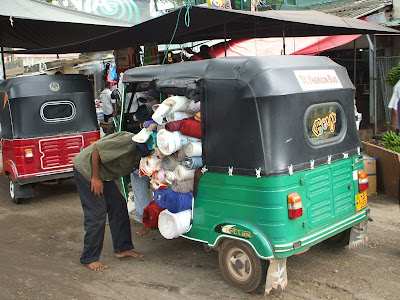
The other form of public transportation is three-wheeling. Three-wheelers are those little vehicles common to many Asian countries but known by a variety of names: becak, bemo, tuk-tuk, (motorised) rickshaw and the like. In Sri Lanka, these mostly come in red, green or beige, with the occasional blue ones. These are able to transport, it seems, 4 or 5 adults or extra if there are children involved. Also, shopping, goods to be sold at market, fish of any size and shape, dogs both large and small, timber, whipper snippers or anything else you would like to move. Three-wheelers mostly try to cling to the sides of the road as their engines are no match for cars, trucks and buses and neither are their chassis, but this is not a hard-and-fast rule and these little smarties on wheels are not afraid to weave in and out of the traffic as necessary. Best to try and avoid being a passenger in a three-wheeler during rain though as visiblity is very limited once the side-flaps are pulled down.


If you don't want to send your kids to school in a three-wheeler, a school van is another option. There are a plethora of vans to be found on Sri Lankan roads at any point during the day and they are commonly used for school or factory transport, as well as driving lessons. I think it may be impossible to limit the number of people you can fit inside a van, especially when you're dealing with children - they're so small. In the morning vans full of white school uniforms, red hair ribbons, sleepy faces, cheeky grins and small, waving hands can be found all over the place. Oh, and point of note, I think it is a fact that people who travel in vans are super cool ;)

The wealthier and those who enjoy a house with car access will probably own a car. Big, black, shiny 4WD seem to be the status symbol here (although other colours are also acceptable). Government ministers drive these, often with a convoy of military bodyguards ahead and behind. They don't yet know that the super-cool people travel in vans.


More common family transport, however, is the motorcycle. Motorbikes are practical if your house doesn't have car access and, at least while the children are younger, you can fit the whole family on there. For a while, apparently, the government passed a law to limit the number of people allowed on a motorbike but when an overwhelming number of indignant families asked, "How are we supposed to travel now?" the government changed its mind. Still, adults are supposed to wear a helmet and it is illegal to keep your mobile phone wedged inside your helmet so you can take calls while riding.

But we can't all be lucky enough to have a motorbike, so there is still always the trusty bicycle. You can't really fit your whole family on the bike but it is usual for there to be two or three people on the bike. Unless, of course, you're on your way to market with your goods strapped on the back. Or you can walk. Few places have footpaths, though, so it's best to stick close to the side of the road. Or, if you are lucky, you might be able to catch a ride in the back of a truck. The rule with trucks, as with three-wheelers, is the more decorated the vehicle, the better it is.


And for those travelling long distances, there is always the train. With open windows and open doors, the trains offer a better ventilated and usually less crowded alternative to bus travel. Word of advice from Darren (who has travelled to the East Coast via rail): it is best for the unseasoned traveller to take a cushion as the seating is rather firm.

So, you see, there are many ways for you to travel around Sri Lanka. You can pick your fancy - just try and avoid the ambulances.

Tuesday, May 18, 2010

'TIS THE SEASON

Here on the West Coast of Sri Lanka we are heading into our rainy season, which runs from May to August. It has marked its arrival with heavy rain, growling skies and intimidating tropical thunderstorms. Sunday night was particularly bad. The perpetual rumblings of thunder had me dreaming that I was in a war zone. The rain was torrential and by yesterday (Monday) morning, with no sign of letting up, many roads were underwater.

Still, life goes on so we set out to take the kids to school as usual. At least with all the rain, there was a lot less traffic about. Only those who had to be out, were out. Yet there were still many to be seen braving it on foot or riding their bikes, holding an umbrella in one hand. I'm not sure how many would manage to see the morning out without being drenched by spray created from vehicles passing through the puddles that now consumed most of the road. We drove past one girls' school where the students were all removing their shoes and socks to wade through knee-high water to reach the school grounds. At one place, we navigated a piece of flooded road while two men, perhaps father and son, watched on from the threshold of their simple home, stranded by a moat of water around their house.

By careful navigation we managed to avoid the flooded streets and make it to the school. However, once there, the thoughts that had been gathering in my mind were confirmed. The school was closed for the day so we turned for home. However, Prince is on holidays so this was our first day with Cedric driving. Cedric was not confident with the roads I had navigated him down to get to the school and wanted to go home via the more direct route. This road tends to be chaotic in the mornings at the best of times but I was happy to let him make the choice.

Sure enough, a large portion of the road was flooded and vehicles from both directions were doing their best to navigate the waters. We were about to turn around and go back (which would be no mean feat as there were now vehicles hedged in behind us) when a man wading out of the waters got our attention. He was carrying an umbrella and wearing nothing but a short sarong and a motorbike helmet (well, that would get your attention!). My immediate thought was, "It must be bad. He seems to have lost his motorbike and taken off all his wet clothes." Yet, somehow I don't think that is what happened (though I can not tell you why he was wandering around the flooded streets wearing a motorbike helmet). Anyway, he seemed to have taken it upon himself to direct the traffic and he convinced Cedric that he would make it through the waters. And he was right. With the sound of water sloshing outside the doors, we took on the giant puddle and won, driving off with Cedric saying, "He was a good man. He was a very good man."

We made it home to surprise Daddy with two energetic little boys with a day off school. It also happened to be the day we had chosen to resume our English/computing classes after 6 weeks in Australia. We were barely expecting to get a class, considering the weather but we were pleasantly surprised. One of the students was coming from a town which had not had any rain yet so she was unaware that there might have been a problem but two who had to catch the bus from South of Colombo had a bus ride that extended to 6 hours through the flooded streets to come to class. The rain eased off throughout the day but returned by evening. Reports were coming in that if the rain didn't stop, Colombo would be losing power as the power stations were almost submerged.

With hopes of better weather, we sent the kids off to school today. However, the rain returned and at lunchtime we received a call asking us to collect the children as the school had to close once again. So Darren went out to face the rain and the roads. It was to be almost three hours before he was to return. Almost every road between home and the school was flooded and choked with vehicles trying to navigate the waters. To add to the situation, adjacent to the school is a factory which was sending all its workers home due to the conditions. In the meantime, the sky was throwing down everything that it had and we now had a river rushing down our driveway, through our yard and back out to our neighbour's property. My phone was able to receive calls but I could not ring out so I was worrying about what had happened to my family. Thankfully, a call from Darren early on had alerted me that this would not be an easy trip and I knew a friend of mine was also waiting on her children to get home from school. Still, it was with great relief that I finally saw the van coming down the drive, right at the point where I couldn't keep anxiety at bay much longer and I was pondering my next move.

At the moment, the rain has ceased and there are no outbursts from the sky; no thunder - either in deafening bursts or subtle rumblings - and no sky-splitting flashes of lightning. There are just the frogs, singing in froggy chorus; a deep bass complimented by a croaky alto with a somewhat syncopated rhythm. There are undoubtedly people trying to find a good place to sleep in flooded homes and hoping that the rain will hold out long enough for mattresses and other things to dry. We'll see how the weather goes tomorrow and perhaps make a call to the school office before deciding whether we'll try sending the kids to school tomorrow. But for now, I'll enjoy the peace, be thankful that my family is safe at home with the kids snug in dry beds and be grateful that all I need to deal with the leaks in my roof is a strategically placed bucket or two.

Friday, February 26, 2010

CLASS IS IN

One of the things we are trying to do while we are here is to give people who can not attend English classes (either because they can't afford them or because of distance) greater opportunity to develop English skills. We want to train and assist volunteers with reasonable English skills to be able to share these skills with others, with the aim of having English programs running in impoverished or rural areas. This will open more career opportunities for the students than what is available to those without any skills in English.

After a year of developing a program for volunteers to use, we have finally been able to begin training our first group of volunteers. We have three volunteers who have been meeting on Saturdays to learn how to share English skills with others in creative ways. They are also learning teaching/classroom techniques. Although this is a small start, we are hoping that it will grow into big things. They have only a few Saturdays left of their training program and then we will assist them in getting their own classes started. The classes will be started as a result of generous donations, but a manageable (read 'small') student fee will allow these classes to continue in a self sufficient manner.

From little things, big things grow.

Friday, February 19, 2010

GIGGLES

Those of you who know us well will know how much we both like a good laugh. We both tend to see the funny side of things (maybe because of the way that we look at them). So, today I thought I might share a couple of things that have caused some giggles.

:) I asked one of my students to translate the sentence, "Ohu kakul mace miladi garnava" (He is buying socks) into English. As she worked through trying to form this into an English sentence (tricky work when you consider that English and Sinhala have very different sentence structures), the word 'chicken' kept coming up. We were all a little confused and then it dawned on us all at once. 'Kakul mace' are socks and 'Kukul mas' is chicken meat. A good giggle for the class. One thing's for sure, I will not be sending her to buy me socks! I'm just relieved that it's not just me who says silly things with Sinhala.

:D English class is a great place for a giggle. The students can always be counted on to say something amusing. If your day needs brightening, just show them a picture and ask, "What is this?" My favourite terminology to date includes the 'teafork' (an implement that makes putting sugar in your tea a difficult task) and 'shoe noodles' (for the pasta fanatic who needs to tie their shoes).

:P At lunch recently, one of our students opened his lunch parcel and exclaimed happily, "I told my wife to put minnows in and she did. She is such a good wife; she listens to what I say." In walks another of our students and she says, "You've got my lunch!" So he gives it back, looks in his actual lunch parcel and says, "She didn't give me any minnows. She gave me prawns. I told her I don't like prawns." I guess it's an easy mistake when you all bring your lunch wrapped in a banana leaf.

:} We spent last weekend in Colombo, with many appointments to keep. When we arrived back home on Sunday afternoon we were all ready for a nap. How can you tell? Because instead of telling Brenton to "Get the gate", Darren instructed his son to "Eat the goat".

Have a happy day!