Tuesday, February 26, 2008

MASSIVE SQUIRRELS


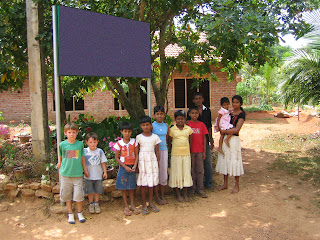
On the weekend we went to Kuliapitiya. We met a man some of you may know, Ari. He currently has eleven children who have no parents to care for them. For some, their parents have died. Most, sadly enough, have parents but they have been abandonded by them. Pictured here are the nine we met (pick the odd two out!) plus one that is Ari's granddaughter. Ari gives them meals and pays for their schooling and book fees. He also does the same for fifteen other children in the community.
At the moment they all live in the main house, boys at one end and girls at the other. This house is overcrowded at best, so he has begun a new building for them. This bulding(pictured) has 3 larger bedrooms, kitchen and bathroom. This is situated on land of approximately one and half acres that he purchased.

As we talked, he told us of his vision to start a technical college to provide futher training to the community children so that they could find jobs. He also wants to provide villagers with a cow or chickens, whose produce can be sold. This is not something that he is just dreaming about but has
already put into motion with what he has. So we are hoping that we can work with him on some of these ideas.


As we were quite close, Prince had arranged to pick up our new pet. We also could see what the locals keep as pets. This cute little fellow is a rock squirrel. He is about three to four times the size of a normal squirel and he is only a baby. The adults grow bigger than a cat and are so fast through the trees, jumping from coconut tree to coconut tree almost like they were flying. It was quite incredible to see.
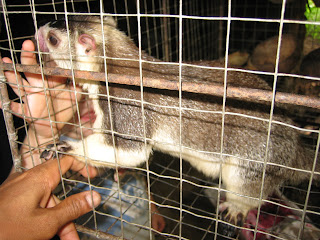
They also had a monkey that was chained up. It seemed quite tame as the owners could pat it and feed it. We, however, were told that it would be best not to get too close. I am not that fond of monkeys and was happy to oblige.

The most bizzzare creature that I have encountered in Sri Lanka is the porcupine. This couple have resorted to keeping these fellows in their house to protect them from other villagers, as apparently they taste good. From what I can see they are rather timid too. They were not content until on their leash and,
despite being spiky fellows, they didn't mind a good pat (make sure you go the right way).

So what did we get? Well, the sqirrels weren't for sale, though we have been offered the next baby they find. The porcupines are like children to them, so we couldn't have them and I will not have a monkey. So we grabbed our tortoise and headed home. He is called Imba, which means turtle in Sinhala. Apparently you have to be careful with the pronunciation though, people, otherwise it might sound like you're swearing. He is slightly too big to escape under the gate and is the resident lawn mower. More on the adventures of Imba later.


Monday, February 25, 2008

PRIORITIES

I read an article over here in an English gossip mag. The article was about how English actress Miranda Richardson had started a not-for-profit organisation to help the stray dogs in Sri Lanka. She said that when she was on holiday in Sri Lanka she was so moved by the plight of the multitudes of stray dogs that she wanted to help, so now her organisation trains people in Sri Lanka to care for the stray dogs. Now, I do agree that it is important to care for animals but it gets you thinking, doesn't it? When there are so many people who struggle to care for themselves, it's funny that taking care of stray dogs is such a priority. When so many men, women and children are living in sub-standard conditions, isn't it a bit strange to be so moved by the plight of stray dogs?

I read another article in a newspaper. The journalist had witnessed the butchering of cows in a rural area and was horrified by what they reported as a barbaric practice. They called for Sri Lankans to put an end to such cruelty by becoming strict vegetarians. Now, I was not there at the slaughter of the cows so I do not know what methods were used, but even as a contented meat-eater I would hate to think that my dinner has been despatched of in a painful and cruel manner. Even so, in a country where thousands upon thousands of people have died at the hands of their fellow countrymen and the wounds that underlie this civil unrest continue to ache and seep, doesn't it strike you as strange that somebody would take up the cause of cattle with such enthusiasm?

Our priorities are funny things aren't they? Is it that focussing on smaller issues allows us to pretend the greater issues aren't there? Is it a case of we simply do what is within our grasp (and I must say that I think that doing something is better than doing nothing). Could we really care about these sort of things more than we care about people? Bit strange, isn't it?

Thursday, February 21, 2008

IT'S A GREAT BIG WORLD OUT THERE

Shortly after our second wedding anniversary, pretty much 9 years ago now, Darren and I found ourselves in Sumatra, Indonesia for 10 days, staying on the shores of Lake Toba. That short stay has left me with many amazing memories but there is one in particular that I would like to share with you tonight.

In the course of events it happened that we found ourselves invited to a local wedding. If there is anything that impressed me about the people we met in Indonesia it was an unfathomable sense of hospitality and generosity. It followed us wherever we went and each person we met, though they owned very little, went out of their way to share what they had with us. It was this that led us to be appreciative guests at a wedding of two people that we did not know.

But it's not the wedding that I am writing about tonight. Instead, it is a fleeting thought that went through my head afterwards that has availed itself of my recollections. After the wedding we were ushered into a small room at the rear of the building for a celebratory meal. At the back of this room was an open doorway that allowed you to see outside. Standing in the frame of that doorway you looked out upon a vast field of rice paddy. As a backdrop to that almost-infinite stretch of green stood a collosal mountain, purple-gray on the distant horizon. I remember thinking, in awe, fancy stepping out your back door every day to that!

That moment, though not profoundly significant, returned to my mind today when I opened my balcony door, looked out and thought (as I often do), "I can't believe this is my world now!" It's that same feeling that I have when I look up at the stars and think, "Wow! I'm actually in the Northern Hemisphere. I have never seen the sky look quite like this before". It makes me want to drag everyone from home over here and make them have a look (even though I'm sure the Southern Hemisphere sky is better - no, of course it's not bias!).

What a privilege it is to be able to see different parts of this amazing planet! I feel humbled that I am so privileged when so many others will never have such wonderful opportunities. And the crazy thing is that all it takes (well, the financial aspect aside!) is for you to realise, "Well, why not?". Sometimes we spend our days taking such small sips of our lives when we could be chugging life down in draughts! And I don't necessarily just mean travelling either. You may stay exactly where you are and the principle is the same: circumstances can dictate the direction of your life or you can stand up and make the decision that, in the end, your life is going to be as close to what you would have had it been as is possible.

So today I have found myself thinking: What are 3 places in the world that I would love to find myself in before this life becomes the next? Here is what I came up with, not in any particular order. I would love to find myself in Japan, perhaps on a bridge over a stream, in the midst of cherry trees all in blossom. I would love to find myself on a Greek island, looking out over a blue-green ocean from an open window or balcony up high on a hill. Down the hillside I can see the whitened homes standing by the alleyways that maze around or lead down to the beach. In this scenario it is mid-morning and I have awoken from a fantastic sleep! Thirdly, I would love to find myself standing outside an ancient building perched in isolation, high atop a mountain, with gentle clouds swirling around me and a mightly river winding it's way through the valleys so far below. Sri Lanka has Adam's peak, so maybe the third scenario might even be a possibility.

So what about you? What three would you pick? What are the 3 places on this planet that you would most want to find yourself? No smarty-pants answers, like "In my beloved arms", you understand what I'm getting at - geographical places only. Here's your chance to get interactive with us. Leave a comment and tell me what you would pick. I'd love to hear your choices.

Monday, February 18, 2008

TALKING THE TALK

So we had our first official Sinhala lesson today. We thought that getting someone from the school would be the best way to approach this. Still, it is hard to trust just anyone and we wanted to make sure that we had someone that we knew was reputable. So we spoke to the registrar at the school, Miss Gomez, who assured us that one of the teacher's wives would be able to assist us. She apparently spoke fluent English, which we were pleased about as it is difficult to understand the Sri Lankan accent at times. So we gave her our number to pass on so that she could contact us, but we got no reply.

After a week or so of missing each other on the phone - I dont generally call back missed calls as it usually results in more broken English confusion - we arranged a meeting with Miss Gomez and the potential teacher. It was Hayley's turn to pick up the boys so she met up with her to assess if her English was good enough. In fact, she was quite surprised at how good Hayley's English was, considering that she thought we wanted ENGLISH lessons. Obviously Miss Gomez thought that my English wasn't that great from the conversations we had and arranged for English lessons! Prince thought this was the funniest thing he had heard for quite some time.
So, in the end, we arranged for Brenton's maths teacher, Ramosha, to give us a hand. The lesson went really well - she had never taught adults and we have never been taught Sinhala. She is quite young (it is very hard to tell the age of people here), has been married 3 months and also speaks fluent English. I think Hayley is the favourite already.

Wednesday, February 13, 2008

GOING THROUGH THE STAGES

I watched a plane fly overhead as I was sweeping the balcony this morning. It got me thinking again about the stages I have gone through as I have worked through coming to terms with living in a new country. Allow me to give you a look inside my mind (scary thought, I know) by describing these stages.

STAGE 1: LIVING OUT OF A HOTEL ROOM
In this stage you are in survival mode. You do your best to make a home out of a single room (plus tiny bathroom) by naming different parts of the room 'kitchen', 'laundry', 'study' and so on. This, however, is more of a mental pursuit and achieves little towards making you feel like you have a home. Survival may also mean pinching bread from the hotel breakfast buffet to try and make school lunches or borrowing the pool towels for the kids' swimming lessons. At this stage you may feel apprehensive about telling locals that you live here, in case they want to send you back, but you also grow sick of being expected to behave like a tourist (no, for the thousandth time, I do not want to go sight-seeing!). However, you still take advantage of certain aspects of tourist life, such as the pool, soft drinks and dining out every night.

STAGE 2: A NEW HOME
Once you have a house you may feel a little more confident about telling people you live here (until you have to admit that you don't really know where your house is and you have no idea what your phone number is!). Don't expect to feel confident about too much else though. You may be afraid to leave your house and each unfamiliar noise can cause apprehension. The noise-phobia will be alleviated when you learn that those sounds are firecrackers - not gunshots! Tension is not so much caused by things that are new and different as it is by not knowing what things might be the same and what things might be different. You can become very aware that you could commit a terrible social blunder at any moment without ever even realising.

STAGE 3: GAINING CONFIDENCE
This is the stage where minor accomplishments take on major significance. You walk around the neighbourhood - maybe even on your own - obviously starting simply, with a walk down your driveway. You buy bananas from a stall around the corner, without the comfort of a translator. You have your first encounter with a large, hairy, foreign spider - and survive. You use your phone. You cross a busy road. You dabble with the local language (albeit just to say thankyou) and they might even understand. You do the everyday things that everyone else around you is doing (in almost the same way). You are aware that people are surprised by your presence but you also know that you are making it - a day at a time.

STAGE 4: AN AEROPLANE FLIES OVERHEAD
It grabs your attention and you watch it go. You think about being on a plane and you think about being at home. You find yourself thinking about all the mundane things you would be doing at home and all the amazing things you are doing because you are here. You also begin to realise that although you might miss many things about home, especially friends and family, you are actually happy here. You realise with satisfaction that this is turning out to be what you had wanted it to be. You also realise that you are now coping well enough with life to be able to have the time to ponder these things, rather than just dealing with surviving.

The plane flies out of sight. I don't know how many more stages there are (we've only been here a little more than a month) and I don't know whether they will be good, bad or in between.
Still, I do know: so far, so good.

Tuesday, February 12, 2008

PUTTALAM

Puttalam, an old fishing and pearling village, is a little place about 90km north of Negombo. Due to the road being in good condition and light traffic we can get there in about two hours. It is situated right next to a huge lagoon. I suspect this may cause flooding issues when it really starts to rain. It is a little place and not many tourists would venture here as most of them would go up to Anaradapura. (When learning Sinhala, reading the place names is good because it is phonetic and you dont have to remember what the words mean).

I was a bit concerned about this trip as I had no part in choosing the place we were staying but as it turns out my fears were unfounded. The place was clean, had a toilet and air conditioner but no hot water, as this is considered an unnecessary luxury in the smaller establisments. However, we were warned to cover up as the mosquitos were quite bad. In the early morning, if you sat quietly, you could hear the buzz of hundreds of mosquitos.

We were in Puttalam for the weekend. On Saturday we were invited to visit some of the families living out there. Driving out from our resthouse we followed the lagoon road, with it's prawn farms and salt flats. Compared with the rest of Sri Lanka these are very sad, sparse places, almost desert-like. There are not many small towns around here and it was a bit of a surprise to come upon a house in the town of Kalpitiya.

With land being relatively cheap here (approximately $60 for one perch or 25 square meters) most families have fair-sized blocks. The houses vary, with some made entirely from woven coconut palms, others with timber walls and tin roof and others still made from bricks and tiles, with all variations in between. The woven coconut palms need to be replaced evey two years while timber posts and boards will last up to five years. Tin is the best when it rains but very hot in the day. The best, and obviously the most expensive, are the brick houses with a tile roof.

Families will tend to forgo any luxury, from new clothes to birthday gifts, just to have a house. They will often live in small thatch places while they accumulate the funds to build a suitable brick house (about $1500). As they are mainly illiterate most onsell goods they buy in Colombo to the wealthier types in Chilaw, which is halfway between Puttalam and Colombo. Items they might sell include such things as skin whitening cream and tooth powder. One lady has been lucky enough to have inherited a sewing machine which will enable her to sell clothes to the community but, as so often is the case, she lacks the money required to complete a training course in sewing and buy material.

The climate here is ideal for growing fruit and vegetables and there is water in abundance. Many in the area grow onions, cabbages, chillies and turnips to sell at markets. However, in this area the ground is sandy, amost beachlike, and requires fertilizer to grow a marketable crop. As the saying goes, you need money to make money.

As we travel back, bellies filled from the hospitality of those we have visited, I realise that the problem is not recognising the needs here. It is using what we have in the best possible way to reach as many people as possible. This is tempered with the thought that whatever we do achieve, some people will miss out. This was reinforced on Sunday, when we met a young man who works for World Vision. They currently help three thousand five hundred children, but there are so many more still waiting for help.
.


Friday, February 8, 2008

A SCHOOL TRIP

Today I visited two Montessori schools in Moratuwa, south of Colombo. In Sri Lanka, Montessori schools are schools that provide pre-school education to children, so they cater for 3 and 4 year olds. The two schools I visited have been set up by Sri Lankan people to provide education for children of impoverished families. Without these schools, the parents of these children would not be able to afford pre-school education, which disadvantages the children when they begin primary school. Also many of these children would not be accepted by other schools. Most families need to pay for their children to be given a place at a school and families who can pay more are more likely to have their child accepted. When places are short, children may be chosen according to whether the family appears to be able to make ongoing contributions to the school. This being the case, it can be difficult for children from poor families to be accepted at a school.

The first school we visited held 25 children, in two class rooms. The children here were practising using scissors and were learning about families. The schools aim to help the children develop their motor and language skills. They also teach the children their numbers and letters, in Sinhala and English. It was quite similar to what an Australian kindy teacher would aim to teach (minus the Sinhala). The difference is in the resources. The children sit in small rooms with no playing space. The front yard is the playground and has no grass, but there were swings and a slide. What caused me the most amazement were the teaching resources. Teachers make almost all their own teaching resources. Just as at home, if the teacher is teaching the letter B, the student will copy the letter B and then colour in a picture of a ball. However, photocopying is not an affordable option, so the teacher will hand draw a ball in each student's book for the children to colour in! Sometimes we think that helping the poor costs more than we can afford, when it can be as simple as photocopying numerous copies of a ball.

The second school we visited has been operating for much longer than the other. This school was inside a two-storey building and also had an adjoining office. The ground floor was one large classroom for the three year olds. Behind the classroom was a kitchen and laundry and out the back were the toilets. The four year olds had classes in the three small classrooms upstairs. This was a much larger building than the first school, but then again, it did have to house 103 students. Out the front was a very small playground, again with no grass but it did have a climbing frame and a row of showers (which I shall talk more about a little further on).

I think my role for the day was to be the teacher's worst nightmare (so that means there are now 5 teachers who have a new worst nightmare). I was taking photos of the students and then showing them their photos on the camera screen. This brought the children great delight and they clamoured around to see. When my memory card became full (oops, too long without cleaning up my camera!) I switched to the video camera and the gates of chaos were opened. All the children wanted to see themselves on the screen and I could not get them to understand that I could not video them if they were behind the camera, so in the end I had to flip the screen and try my best to video what I couldn't see. They all stood as close to the camera as they could so their heads filled the screen. There was pushing and shoving and shouting and general confusion. The teacher would try and regain order by having the children sing for me, which they gladly did at the very top of their little lungs. It is surprising how loud a group of small children can be. Once order was returned to the classroom I would be ushered into the next classroom and the whole uproarious procedure would begin again.

After I had visited each classroom, the whole school gathered downstairs for more hearty singing and a story. After this they had lunch, which the school supplies. Today was rice and curry for all the children except one. I was told that he was a young baby at the time of tsunami and that after the tsunami his family could not afford to buy rice. This meant that he had never learnt to eat rice the customary way (by rolling it into a ball with his fingers and then placing in the mouth) and did not have the dexterity to eat rice like the others. He would go home and eat a special cereal with his family. For many of the other children, the lunch that the school supplies would be their only meal for the day.

After the children cleared up from lunch it was the end of their school day and they were handed back to their parents or grandparents. However, 26 students were to stay for daycare which the school offers to take care of children whose parents are working. If it were not for daycare these children may be left unsupervised at home or playing on the streets. There are hopes to start a daycare for the smaller school as well. The daycare children sat listening to some music while the teachers had their lunch. I told the children a story with Prince's help. It was very difficult to get them to listen because they found me so very exciting and strange. I soon learnt that I didn't really need Prince to translate because they didn't care so much for the story. They were laughing so hard just listening to me and watching my funny actions and copying my body language and facial expressions. They particularly liked it when I acted out the growling lion and the dancing king!

After the teachers have eaten it is time for the children to prepare for a nap. First they will shower (hence the forementioned showers in the playground). The children change into underpants that the school supplies so that they can shower modestly. They will then play in the yard until it is their turn to shower. I think that maybe six children could shower at a time. One teacher takes responsibility for soaping the children and another takes responsibility for drying the children. The drying teacher has a basket of towels for each child to use and another basket that the towels and wet underpants can go in for laundering. The children will then dress themselves in clothes from home, with the assistance of another teacher. I thought it was enough rigmarole going through bath time at home with my own children. Fancy doing it every day with 26 children!

While the children have been showering, the other teachers have been setting up for naptime. The children have stacked their chairs and the tables have been moved away and now large mats are rolled out on the floor and covered with sheets. Pillows are placed down, not one for each child as there isn't enough room, but two little heads don't mind sharing one pillow. The children finish dressing and, one by one, they come and take a place on the mat, girls in one row, boys in another. I wonder how they ever get these excited little children to sleep but one little girl is asleep almost immediately. Each time I count there are a few more children sleeping and the others, although wriggling, are lying quietly. I know that my presence there is quite a distraction to these little ones and that it would take us a few hours to get home again. Quite keen to get back to my own little ones, I take this as my cue to say my goodbyes and thankyous and quietly slip away.